
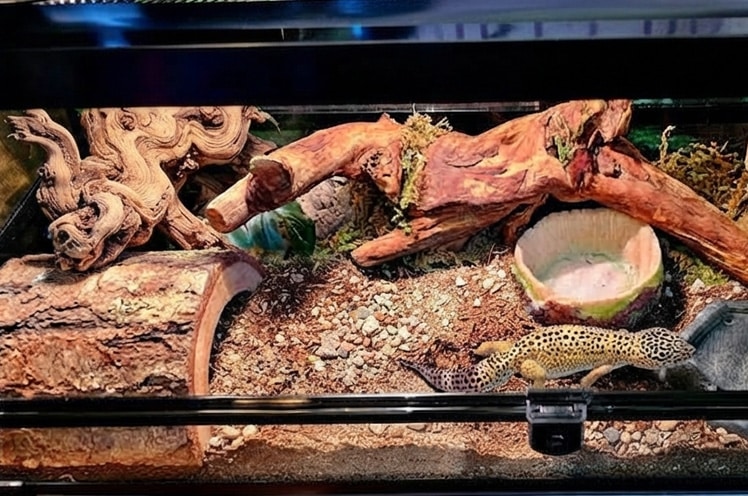
If you’re setting up a home for a leopard gecko, the short answer is below — but the “right” tank size depends on more than just a gallon number, and getting it right from the start will save you money and hassle.
The common advice of “get a 20-gallon” only tells you part of the story. I’ve built and rebuilt enclosures for leopard geckos since 2018, and the difference in how a gecko uses a bigger, well-laid-out space versus a bare-minimum one isn’t subtle once you’ve watched it happen. That gap between “surviving” and “thriving” is where most of the outdated advice still floating around falls short.
In this guide, I’ll walk you through exactly what size tank your gecko needs at every life stage, break down why the “20-gallon minimum” and “bigger is always better” camps rarely agree, and point you toward tanks that’ll actually work well long-term.
The Leopard Gecko Tank Size TLDR:
- A single adult leopard gecko needs at least a 20-gallon long tank (30″x12″x12″) — but most modern keepers recommend starting at 36″x18″x18″ or larger for a healthier, more enriched enclosure.
- Floor space matters more than height. Leopard geckos are ground-dwellers, so a long, low tank always beats a tall, narrow one of the same volume.
- Hatchlings need less room, not more — start at 10 gallons and size up as your gecko grows. A too-large tank can stress out a young gecko.
- Don’t rely on the gallon number alone — two tanks labeled “20 gallon” can have very different footprints. Check the actual length x width x height.
- See the full age-by-age sizing chart and tank recommendations below.
Disclosure: TerraKeeperHQ.com is a participant in the Amazon Services LLC Associates Program, as well as other affiliate programs, designed to provide a means for us to earn fees by linking to Amazon.com and affiliated sites at no extra cost to you. Please see the Affiliate Disclosure for more details.
Prices and review counts reflect Amazon listings as of September 2026 and are subject to change — check the linked product page for current numbers.
Quick Leopard Gecko Tank Recommendations
| Tank | Best For | Price | Details |
|---|---|---|---|
| Zilla 10-Gallon Starter Kit | Hatchling / juvenile starter | $109.99 | Full review ↓ · Amazon |
| REPTI ZOO 20 Gallon | Budget adult, minimum size | $170.00 | Full review ↓ · Amazon |
| REPTI ZOO 34 Gallon | Step-up size, mid-range | $150.00 | Full review ↓ · Amazon |
| Carolina Custom Cages 36″x18″x18″ | Premium adult build | $270.00 | Full review ↓ · Amazon |
Prices and ratings as of September 2026 — see full disclosure above.
The Great Debate: “20 Gallon Minimum” vs. “Bigger Is Always Better”
If you’ve spent any time in gecko forums or Facebook groups, you’ve probably run into two very different camps giving you very different advice — and both will tell you they’re right.
The 20-gallon minimum
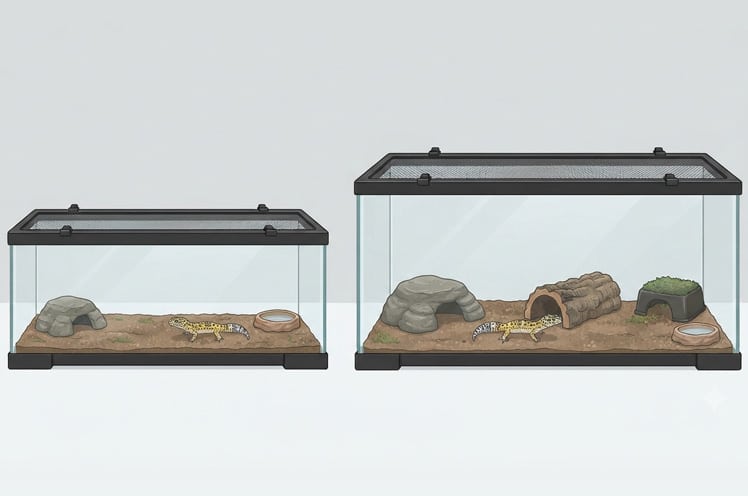
This is the number you’ll see on most pet store care cards and older care sheets — and it’s not just internet folklore. Even the Association of Reptile and Amphibian Veterinarians’ own client handout states that a 10- to 20-gallon long aquarium is large enough to house one or two leopard geckos from hatchling to adult size. The logic is straightforward: leopard geckos are small, relatively low-activity lizards that spend a lot of time hiding, so a 20-gallon long (30″ x 12″ x 12″) tank gives them enough floor space to move around, thermoregulate between a warm and cool side, and feel secure without excess open space that might stress them out.
This isn’t wrong, exactly — a leopard gecko will survive and can even do fine in a 20-gallon tank, and it’s the position of a credentialed veterinary organization, not just an outdated pet-store card. But “will survive” and “will thrive” aren’t the same standard, and that gap is exactly what the second camp pushes back on.
Bigger is (almost) always better
Over the past several years, a growing number of experienced keepers and reptile welfare advocates have pushed back on the 20-gallon standard, and honestly, I’ve come around to their side. ReptiFiles, a reptile-welfare research and care site, makes the case directly: reptiles will utilize every inch of space that we make available to them, and larger, enriched enclosures encourage pets to exercise more, which in turn keeps them healthier and helps them live longer — a direct rebuttal to the old idea that geckos get “overwhelmed” in bigger spaces. ReptiFiles®
A bigger footprint — commonly cited as 36″ x 18″ x 18″ (roughly 40-50 gallons equivalent) as a starting point for a single adult — allows for real temperature gradients, more natural exploration, and a lot more room to create an enclosure that doesn’t just contain your gecko, but actually gives it a life. The one place this doesn’t apply is hatchlings, where too much open space early on can actually work against a young gecko — more on that in the age chart below.
Going bigger isn’t free, though. It’s worth being upfront about the tradeoffs: a larger glass tank costs more, needs a more powerful (and pricier) heating setup to actually produce a real gradient instead of an underpowered, uneven one, and gives a shy or unwell gecko a lot more space to hide in — which can make it harder to notice if something’s wrong. None of that changes my recommendation, but it’s part of the honest picture.
The way I see it
After eight years of building gecko enclosures, my honest take is this: 20 gallons is a solid, veterinarian-backed baseline, not a ceiling. If budget or space is genuinely tight — you’re a first-time reptile keeper, working with a small apartment, or just want to try keeping before committing further — a properly set-up 20-gallon long is fine for a single adult, and I’m not going to tell you your gecko is suffering in one. You can always upgrade once you and your gecko are settled in.
But if you’re setting up a new enclosure from scratch and have roughly $150-200 to spend once, I’d start at 36″ x 18″ x 18″ or larger — it’s not meaningfully more expensive at the outset, and the difference in how your gecko uses the space is noticeable. Bigger tanks also give you room to grow if you ever want to make the enclosure bioactive down the line.
Quick Reference Table: Leopard Gecko Tank Size By Age
| Age | Recommended Tank Size | Dimensions (approx.) | Why This Size Works |
|---|---|---|---|
| Hatchling (0–6 months) |
10 gallons | 20″ x 10″ x 12″ (51 × 25 × 30 cm) |
Smaller space makes it easier for young geckos to find food and feel secure; less ground to patrol means less stress |
| Juvenile (6–12 months) |
15–20 gallons | 24″–30″ x 12″ x 12″ (61–76 × 30 × 30 cm) |
Growing gecko needs more room to establish separate warm/cool zones as body size increases |
| Sub-adult (12–18 months) |
20–30 gallons | 30″–36″ x 12″–18″ x 12″ (76–91 × 30–46 × 30 cm) |
Transition size — a good point to move toward the adult enclosure rather than upgrading twice |
| Adult (18+ months) |
~40–50 gallons | 36″ x 18″ x 18″+ (91 × 46 × 46+ cm) |
Full-grown gecko benefits from real thermal gradients, enrichment, and room to explore |
Tip: many keepers skip the hatchling-specific tank entirely and go straight to a properly set-up juvenile-sized enclosure with extra hides to compensate for the larger space — it saves you from buying (and setting up) three or four tanks over your gecko’s first two years.
Why Leopard Gecko Tank Size Matters (Beyond The Need For Room)
It’s easy to think of tank size as just a comfort issue — more room, happier gecko. But the real reasons size matters go deeper than that; here are some things I think you might want to know.
Thermal gradients need physical distance to work.
A leopard gecko’s entire ability to regulate its body temperature depends on moving between a warm side and a cool side of the enclosure throughout the day. According to ARAV’s client care guidelines, the enclosure should offer a gradient of roughly 73–90°F end to end — many keepers run the warm side toward the higher end of that range and let the cool side drop toward the low 70s at night. In a cramped tank, that gradient gets compressed into just a few inches — nowhere near enough physical distance to hold a 15-20°F difference between the two ends. A properly sized enclosure gives you the physical space to create a real gradient, which is the actual mechanism that keeps your gecko healthy, not just a nice-to-have.
Naturalistic behavior needs room to happen.
Leopard geckos are more active than most people assume. They patrol, dig, climb over rock and wood features, and explore new corners of their environment daily — a point reptile welfare researchers have made directly in response to older advice that geckos get “overwhelmed” in larger spaces: in reality, reptiles use every inch of space made available to them. A tank that’s just “big enough to survive in” doesn’t leave room for any of that. A larger, well-laid-out enclosure lets your gecko actually behave like a gecko instead of just existing in a box.
Multiple hides need multiple zones.
Every leopard gecko enclosure needs at least three hides — a warm one, a cool one, and a humid one for shedding — which lines up with ARAV’s own guidance to provide hide boxes on both the warm and cool sides plus a dedicated humid hide. Each one needs to sit in the right thermal zone to do its job. If you try to cram those hides into a small tank and the zones overlap so much that the hides stop being meaningfully different from each other, it defeats the purpose.
Leopard Gecko Tank Size and Shape: Length vs. Height
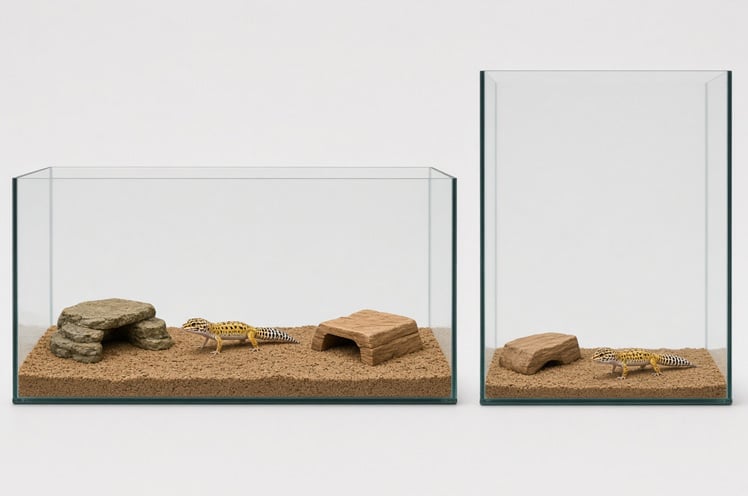
Not all tank size numbers are created equal — a 20-gallon “long” and a 20-gallon “tall” hold the same volume of air, but they’re completely different environments for a leopard gecko, and only one of them actually works.
Leopard geckos are terrestrial, not climbers
Unlike crested geckos or other arboreal species that spend most of their time climbing and perching above ground, leopard geckos live almost entirely on the floor of their enclosure. In the wild, they’re ground-dwellers that shelter during the day beneath rocks and in burrows rather than up in vegetation. That means floor space — length and width — is what actually matters for their day-to-day life, not vertical height.
Why a “tall” tank is a wasted opportunity
A tall, narrow enclosure might look impressive on a shelf, but for a leopard gecko, all that vertical space above the substrate line is essentially unusable. It doesn’t give your gecko more room to explore, more room for a proper thermal gradient, or more room for hides — it just adds empty air your gecko will never interact with. If you’re choosing between two tanks with the same gallon capacity, always pick the one with more floor footprint over the one that’s taller.
What to actually look for
When shopping for a leopard gecko enclosure, prioritize length and width first, and treat height as secondary — most standard “long” style tanks (as opposed to tall “high” tanks of the same volume) are built with this ratio already in mind. A general rule of thumb: height only needs to be enough to prevent your gecko from climbing out and to allow a comfortable substrate depth; usually 12–18 inches is plenty even in a large adult enclosure.
If you want a single number to shop by instead of comparing gallons: the adult footprint from the age chart above (36″ x 18″) works out to roughly 650 square inches of floor space — that’s the figure to look for regardless of how a given tank’s gallon capacity is labeled, since (as covered earlier) the same footprint gets marketed as anywhere from a “40 gallon” to a “50 gallon” depending on the brand.
A quick contrast worth knowing
This is actually the exact opposite of what you want for an arboreal species like a crested gecko, where vertical height matters more than floor space since they spend most of their time climbing rather than walking. If you ever keep both, don’t assume what works for one setup will translate to the other — it’s a completely different set of priorities.
Best Leopard Gecko Tanks By Size
Rather than one generic “best tank” pick, here are some tank options for each stage of life and different budget levels.
| Tank | Best For | Price Tier | Humidity Retention | Ventilation | Realistic Add-On Cost |
|---|---|---|---|---|---|
| Zilla Desert Starter Kit 10 Gallon |
Hatchling / juvenile starter | $ | Moderate | High | +$25–35 (heat mat + thermostat swap) |
| REPTI ZOO 20 Gallon Front-Opening |
Budget-conscious adult, minimum size terrarium | $ | Low | High | +$10–15 (humidity cover/foil tape) |
| REPTI ZOO 34 Gallon with Foam Background |
Step-up size between juvenile and full adult build | $$ | High | Moderate | +$5–10 (silicone for background gaps) |
| Carolina Custom Cages 36″x18″x18″ |
Premium build quality & security | $$$ | Low | High | +$60–90 (sold empty — substrate, background, hides, heat mat) |
Price tiers are relative to each other, not fixed dollar amounts — check current pricing before you buy.
Best Leopard Gecko Starter Kit (Hatchling/Juvenile): Zilla Desert Reptile Starter Kit — 10 Gallon
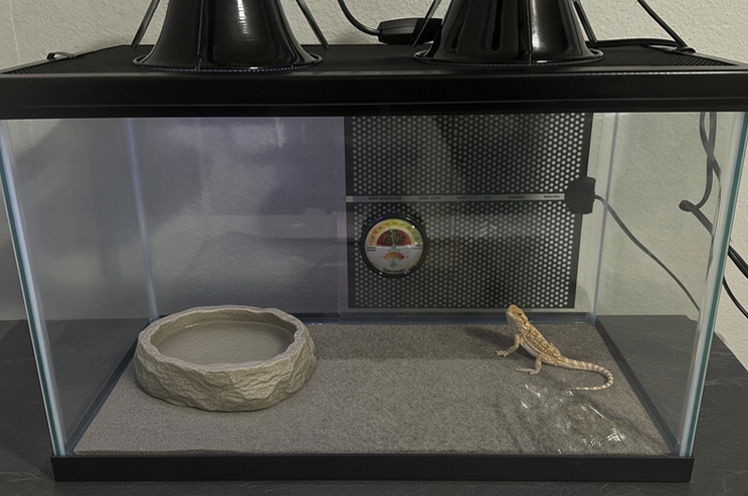
A complete starter bundle built around a 10-gallon glass aquarium — includes two reflective dome light fixtures, a nighttime black heat bulb, a daytime white spot bulb, a screen cover, a humidity/temperature gauge, and an odor-fighting terrarium liner substrate.
Pros:
- Genuinely complete for the price — tank, lighting, heat, basic substrate, and a gauge all in one box
- Correctly sized for the hatchling stage from the age chart above
- All Glass Aquarium (Zilla’s parent brand) has a long track record in the reptile hobby
Cons:
- Heat comes from two overhead dome bulbs, not under-tank heating
- Does not include UVB lighting
- The included terrarium liner is a carpet-style liner, not loose substrate — some keepers prefer this for hatchlings, others prefer paper towel for easier spot-cleaning
What you should know about this kit:
The overhead heat lamp doesn’t match how leopard geckos actually thermoregulate in the wild — they warm themselves against sun-heated rock and sand, not overhead light. Budget for an under-tank heat mat + thermostat (~$25–35) if you want to set this up the way most experienced keepers eventually do.
If you want to add UVB later, budget for a low-output T5 strip too — this kit doesn’t include one, and low-level UVB is increasingly recommended even for a nocturnal species like this. The dual dome fixtures also mean two open bulbs radiating heat into the room — keep the tank away from curtains or anything flammable, and double-check bulb wattage against your room temperature so you don’t overheat a 10-gallon space. On security, the screen cover uses simple clips rather than a locking mechanism — fine for a docile hatchling, but check the clips are fully seated after every feeding.
Don’t buy if: you’re setting up for a sub-adult or adult gecko — this is sized for the hatchling stage only from the age chart above, and you’ll outgrow it within months.
Cost: $109.99
4.4 Stars (669 Amazon Reviews)
Best 20 Gallon Adult Leopard Gecko Tank: REPTI ZOO 20 Front-Opening Terrarium
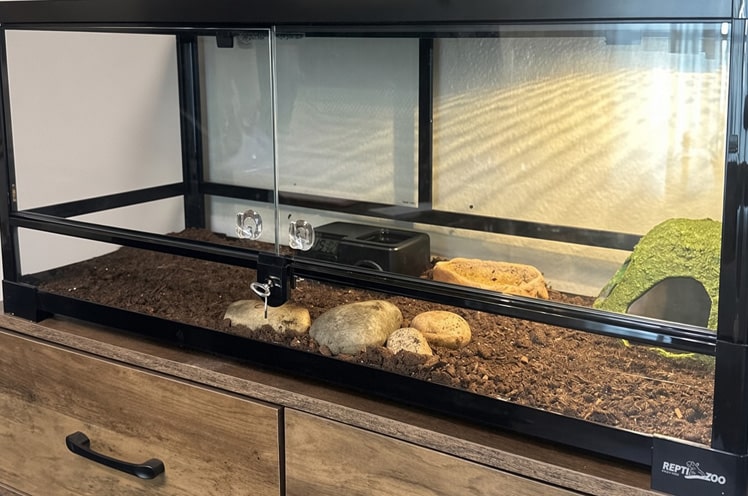
A straightforward option if you’re sticking with the traditional 20-gallon standard. At 30″ x 12″ x 12″ (76 × 30 × 30 cm), it works out to roughly 360 square inches of floor space — well under the ~650 sq in you’d get from an adult-sized 36″x18″x18″ setup, but in line with the 20-gallon baseline covered in the debate section above.
Pros:
- Front-opening doors make daily feeding and maintenance far easier than lifting a top lid
- Screen top provides strong airflow
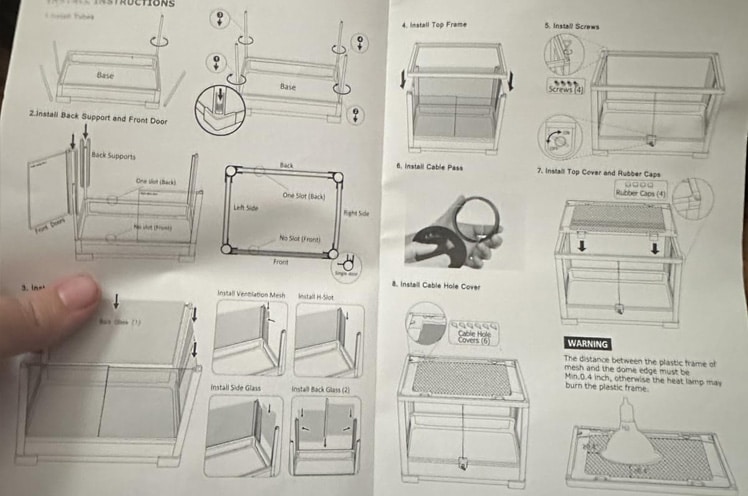
- Simple, quick assembly
Cons:
- Screen-heavy top vents humidity out quickly, which can work against you during shedding
- Front-opening door latches are a moving mechanical part worth checking on arrival and periodically thereafter
What you should know about this terrarium:
Plan on covering 80–90% of the screen top to hold humidity in the 30-40% range, and keep a dedicated humid hide to compensate the rest of the way — budget a roll of foil tape or a humidity cover panel (~$10) as a near-guaranteed add-on purchase. The heavy screen top also lets in more ambient room light than a solid-top tank, so this one benefits from a covered or dimly lit room at night.
Don’t buy if: you’re planning a bioactive setup with live plants that need stable ambient humidity — the heavy screen top will fight you constantly. A more glass-dominant enclosure (like the option below) holds humidity more consistently.
Cost: $170.00
4.5 Stars (293 Amazon Reviews)
Best “Bigger Is Better” Upgrade: REPTI ZOO 34 Gallon Terrarium REPTI ZOO 34
A solid middle ground if a 20-gallon feels too small but a full 36″x18″x18″ adult setup is more than you want to commit to right now. At 24″ x 18″ x 18″ (61 × 46 × 46 cm), it works out to about 432 square inches of floor space — noticeably more than the 20-gallon option above, though still short of the ~650 sq in you’d get from the full adult-sized enclosure covered next.
Pros:
- Real step up in floor space over a 20-gallon without jumping straight to the largest option
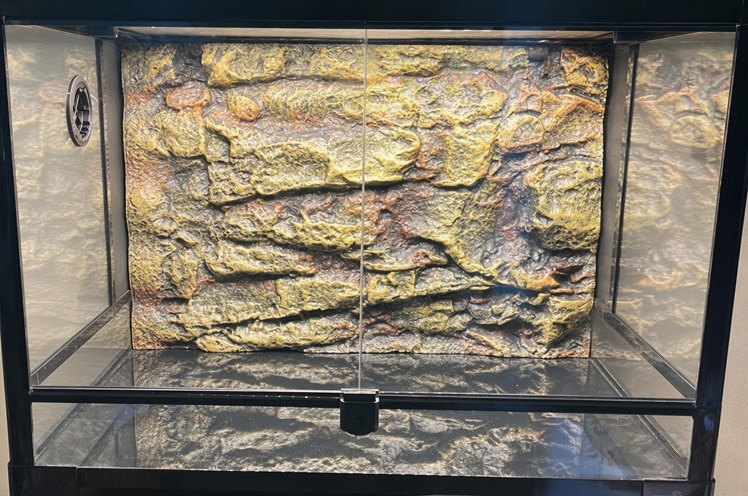
- Included foam background saves you a separate purchase
- Breaks down flat for storage or transport without tools
Cons:
- Foam background can leave small gaps at the edges
- Glass panels are orientation-specific during assembly and can be confusing the first time
What you should know about the REPTI ZOO 34:
First off, my advice would be to seal background gaps with aquarium-safe silicone before introducing your gecko — a determined lizard, or an escaped feeder insect, can exploit more space than you’d expect. Once filled with substrate, décor, and water, a tank this size adds up fast — check that your stand or furniture is rated for the load before setup, not after. The mostly-glass construction holds both humidity and nighttime darkness well compared to the screen-heavy 20-gallon option above, which is a genuine advantage at this size.
Don’t buy if: you’re setting up for a hatchling or early juvenile (still too big — see the age chart), or if you know you want the full adult-sized enclosure from the start; in that case, skip ahead to the option below and save yourself a second purchase.
Cost: $150.00
4.6 Stars (677 Amazon Reviews)
Best Premium Leopard Gecko Option: Carolina Custom Cages 36″ x 18″ x 18″ Terrarium
A US-made, all-glass terrarium built by a company that specializes in custom reptile enclosures — hinged doors with key-lock security, a 4″ deep waterproof base tray, and a full steel mesh screen top.
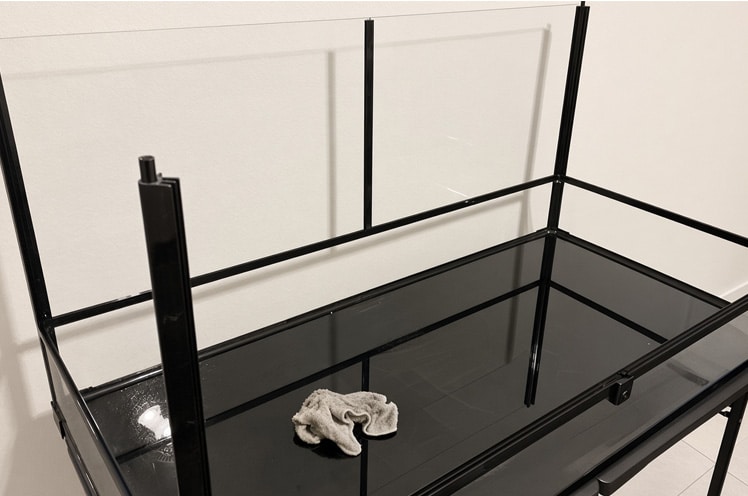
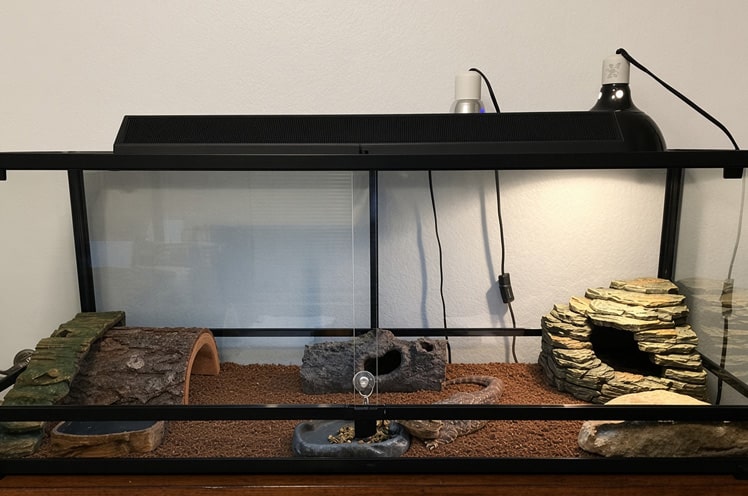
Pros:
- Genuinely sturdy, made-in-the-USA build quality
- Key-lock security on the doors — a real step up from clip or latch closures
- Waterproof base tray protects against spills and substrate leaking into door tracks
- Glass sides (not plastic) resist scratching from claws over years of use
Cons:
- Sold completely empty — no substrate, heating, lighting, or background included
- Full steel mesh top means ventilation is very high, which works against humidity retention
- No starter kit bundle at any price point from this brand
What you should know:
Since it ships empty, realistically budget an additional $60–90 for substrate, a background, hides, a water dish, and an under-tank heat mat + thermostat. It’s also on the heavier side even before you fill it — see the note on stand weight in the Common Mistakes section below before you buy. The 4″ deep waterproof base tray is worth knowing about too — plenty for standard substrate, but if you ever want to go bioactive with a deeper substrate stack, check whether a deeper base model fits your plans better before you buy.
Don’t buy if: budget or humidity retention is important.
Cost: $270.00
4.6 Stars (1,458 Amazon Reviews)
A note on gecko cohabitation:
Regardless of which tank you choose, I’d recommend housing leopard geckos alone. Older guides (including some vet-provided care sheets) treat small female groups with one male as acceptable, but more recent welfare-focused observation has noted aggression when a new individual is introduced to an existing group, along with the risk of competition over hides, food, and space — the same resource-competition problem covered earlier in this guide. Given that risk, and that leopard geckos show no evidence of needing companionship, solitary housing is the simpler, safer default. If you see a tank marketed for “multiple reptiles” or a dual-habitat stand, that’s not a recommendation to house two leopard geckos together — it’s meant for keeping different species separately side by side.
Common Leopard Gecko Tank Size Mistakes to Avoid
Having built and redesigned leopard gecko tanks since 2018 — and helping plenty of other keepers troubleshoot theirs — these are the tank-size mistakes I see most often.
Buying a “tall” tank instead of a “long” one
Leopard geckos are floor-dwellers, so vertical space is wasted space — see the Length vs. Height section above for why. If you’re comparing two tanks with similar gallon capacity, always check the actual footprint dimensions, not just the volume.
Starting an adult-sized tank for a hatchling
It’s tempting to buy the “final” tank once and skip the upgrades, but a too-large space can genuinely stress out a young gecko — it makes food harder to find and cover harder to reach quickly. Follow the age-based chart above rather than jumping straight to the endpoint.
Assuming gallon size alone tells the whole story
Two tanks can both be labeled “20 gallon” and have completely different footprints depending on whether they’re built long and low or tall and narrow. Always cross-check the actual length x width x height dimensions, not just the gallon number on the box.
Underestimating weight once the tank is full
This one catches people off guard more than any other on this list. Even the tank itself is heavier than most people expect — a 36″ x 18″ x 18″ glass terrarium alone typically weighs around 55-60 lbs before anything goes inside it. Once you add substrate, décor, and a water dish on top of that, the total climbs fast and easily clears 100 lbs for a tank this size, depending on substrate depth and type. Don’t guess — set the empty tank in place first, confirm your stand or furniture handles that weight, then add substrate in stages and reassess before you assume the final setup is safe.
Housing two leopard geckos together to “save space”
A bigger tank isn’t a substitute for giving each gecko its own enclosure — see the cohabitation note above for why this is a welfare issue, not just a logistical one.
Not planning for the upgrade path
Geckos grow fast in their first year. If you buy piece by piece without a plan, you can end up buying three or four tanks in 18 months instead of two. Look at the full age chart above before your first purchase, and decide now whether you’re doing the gradual upgrade path or skipping straight to an adult-sized enclosure with extra hides in the meantime — both work, but pick one on purpose rather than reacting size by size.
Leopard Gecko Tank Size FAQs:
What size tank does an adult leopard gecko need?
At minimum, a 20-gallon long tank — a size still supported by some veterinary care guidance. Most modern keepers recommend going bigger: 36″ x 18″ x 18″ or larger, for a healthier, more enriched enclosure with room for a real thermal gradient.
Does tank shape matter, or just the gallon size?
Shape matters more than the gallon number. Leopard geckos are ground-dwellers, so floor space — length and width — matters far more than height. Always check the actual dimensions rather than relying on the gallon label alone.
How often do I need to upgrade my leopard gecko’s tank?
Typically two to three times as your gecko grows — from a 10-gallon hatchling tank, to a 15-20 gallon juvenile size, to a 36″ x 18″ x 18″+ adult enclosure. Some keepers skip the middle step by starting with a properly set-up juvenile tank and going straight to the adult size next.
Is a bigger tank always better for a leopard gecko?
Almost always, with one exception: don’t start a hatchling in a full adult-sized tank. A too-large space can make it harder for a young gecko to find food and feel secure. Beyond the hatchling stage, more floor space is consistently a benefit, not a risk.
To Sum It All Up
At the end of the day, tank size isn’t just a box to check off your leopard gecko setup checklist — it’s the foundation everything else builds on. Get it right, and thermal gradients, humidity control, and enrichment all become easier. Get it wrong, and you’ll spend the next year fighting a space that was never big enough to begin with.
If you take away just one thing from this guide, let it be this: 20 gallons is a minimum tank size, not a target. Whenever your budget and space allow, size up — your gecko will use every extra inch of floor space you give it.
Got questions about your specific setup? Drop a comment down below or reach out to me on the contact page.

- Leopard Gecko Tank Size Guide: From Hatchling to Adult - September 14, 2026